
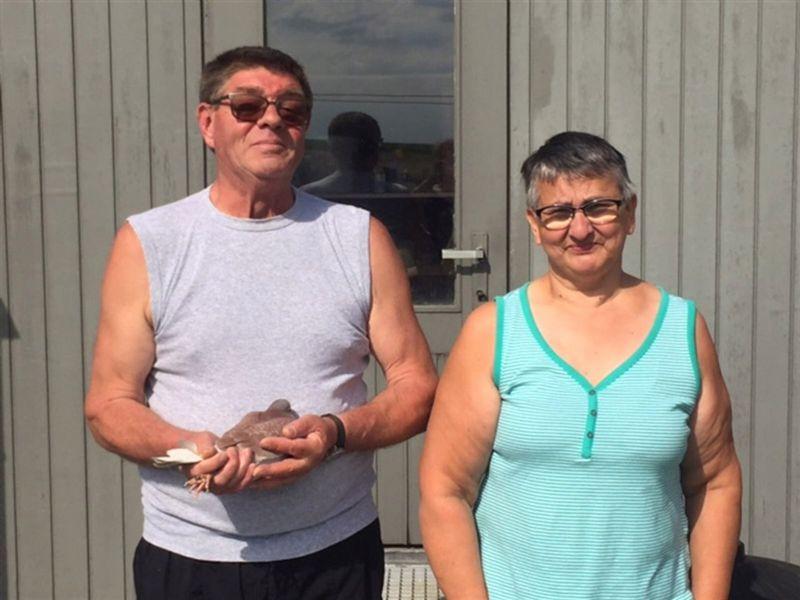
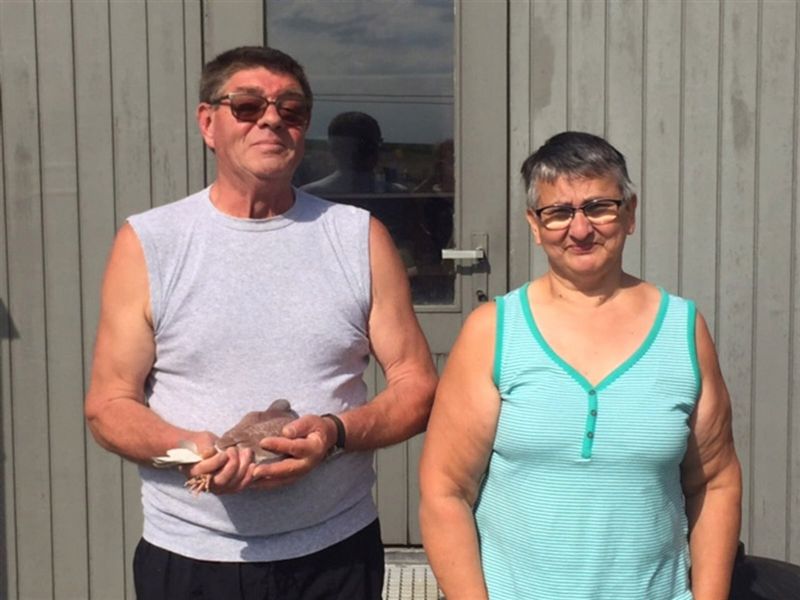
After a long career of 40 years as a construction worker, Jo (67) retired a few years ago and was able to fully dedicate himself to pigeon racing. And not without success, one might say! One of the highlights of recent years: 1st national Limoges II against 9102 old pigeons and also the fastest pigeon among 19638 pigeons in 2017!
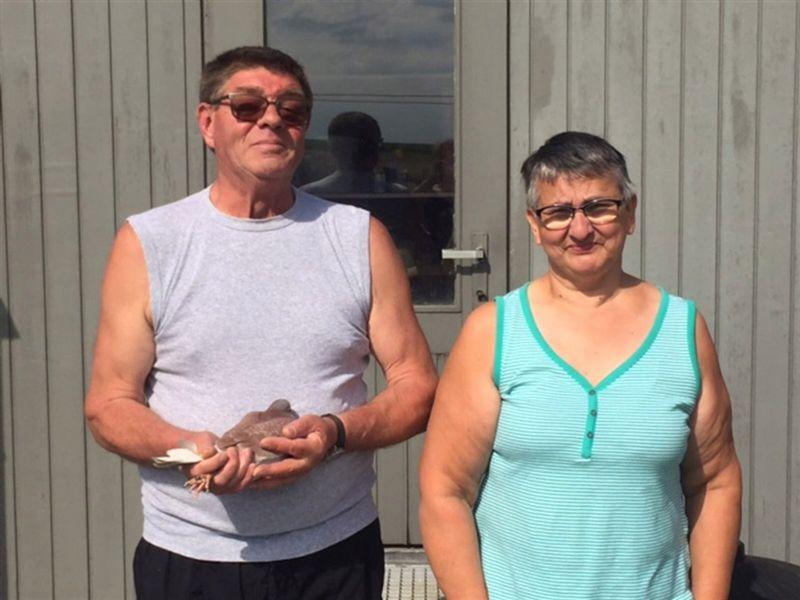
8 provincial victories in the Long Distance races are listed in the rich palmarès here in Appelterre, and in 2009 he won the 2nd national championship Grote Fond 2009 and in 2010 became 4th National Champion KBDB Fond. Over the years, Jo also collected numerous beautiful national top prizes with the lines of:
“De Cahors”
- father 1st national Limoges 2017
- flew himself
- 1st Limoges 235 pigeons/ 62nd national Limoges 11969 pigeons
- 1st Cahors 105 pigeons/ 24th national Cahors 9651 pigeons
- 2nd Souillac 134 pigeons/ 74th national Souillac 7597 pigeons...
“De Provinciaal”
Won 1st provincial Narbonne/ 5th national & 6th international Narbonne
“Zoon Montauban-ken”
Founding father and father of 1st provincial Agen also 21st national & 42nd international
“De Victor”
Brother of “Zoon Montauban-ken” and father of 1st international Narbonne 2011
These last 2 are sons of the famous “Montauban-ken”:
In the year 2002, Jo reached out to Luc Van Coppenolle in Ouwegem and bought a series of eggs there. A shot in the dark, as it would later turn out. From one of these eggs was born the famous 'Montauban-ken', whose genes now run through more than 60% of the colony. If there exists a hen with golden eggs, then this lady comes pretty close. Born in 2002, this hen has produced numerous top 100 winners at national level so far. Both children, grandchildren, and great-grandchildren.
In this sale, you will find all these champions in the pedigrees.
History
In 1968, Jo started with the pigeons on the parental land together with his father. Like most fanciers, it began with sprint racing, before switching to middle distance in the mid-'70s. The long-distance debut came in 1982. However, the first years were with varying success. Until Jo made his mark in 1987. On a very heavy Lourdes, where the pigeons were released on Sunday morning, he clocked in on Monday around 3 PM as 1st local and 2nd provincial. This tasted like more and step by step he worked towards a loft capable of competing with the top in long-distance and heavy long-distance races. Years passed, and the search for better continued. In 2002, Jo landed at Luc Van Coppenolle from Ouwegem, where he bought 8 pairs of eggs, and one pigeon from these eggs became Jo’s founding hen, “Montauban-ken.”
Additionally, Jo also bought a lot from Rufin & Luc Buyl from Nieuwenhove, where he received a pair of eggs from the “Kleine Blauwen,” which itself flew 2nd national Brive. One of these males became the permanent partner of the “Montauban-ken.” A foundation pair was born.
The racing team consists of 45 males. Jo takes the bachelors away 4 to 5 times a season from 15 to 30 km and then immediately heads towards Noyon. To motivate the males at the beginning of the season, their partner is shown before the racing. After about 4 races, he stops this; from then on, the males know the game normally. The basketing for the long-distance races is done as quietly as possible.
In the loft, you will find no complicated feeding schedules during the racing season. No, simplicity rules. This has partly to do with the past. When he was still working, he could only feed the pigeons once a day. And as it worked back then, Jo continues to do it this way. During the racing season, the bachelors always receive the same mixture. There is no form of recovery mixture or extra feed. This fixed mixture, composed by Jo himself, consists of various types of sports and energy mixtures.
To keep the entire colony fit throughout the year, Jo mainly uses by-products from Vaesen and Bax.
Ultimately, the medical aspect is simple. Before the season starts, he visits veterinarian Bjorn Geeroms for the mandatory vaccinations and a medical check-up. If necessary, treatment will happen; otherwise, not.
Jo strongly believes in the wingle theory: In the early 1980s, Jo delved into the wing theory of Vanderschelden, and this is still the way he selects his pigeons. They must have wings like a swift, capable of racing hundreds of kilometers in one single flight. When you take the pigeon in your hand and open its wing while looking at it straight on, it should bend inwards as much as possible. But especially the wing must be examined after a heavy race. After the flight, the feathers are 'straight', but the next day they must already bend inwards again; if not, the pigeon doesn’t have a long-distance career.
Other important aspects Jo looks at to improve his pigeon colony include keeping the pigeons super healthy with natural products, a well-ventilated loft, and breeding from pigeons that performed strongly themselves and have a good breeding eye.
Some champions from recent years:
BE18/4126655
2020
- Valence local 11th
- Montélimar Local 3rd
- Brive local 20th
2021
- Valence local 9th
- Montélimar local 4th
- Narbonne local 17th
2022
- Valence local 23rd
- Montélimar local 6th
- Narbonne local 5th
2023
- Bergerac local 10th
- Narbonne local 4th
BE21/4028690
2022
- Bourges local 211th
- Chateauroux local 11th
- Tulle local 120th
- Brive local 1st & 40th national
BE21/4028709
2022
- Bourges local 269th
- Chateauroux local 168th
- Souillac local 1st & 6th national
2023
- Souillac local 15th
- Aurillac local 32nd
- Limoges I local 106th
- Limoges II local 80th