


Genetics Explained Simply
Imagine that each pigeon carries a unique cookbook. This cookbook contains chapters that we call chromosomes. Within each chapter, there are specific recipes known as genes. Each recipe is made up of special letters, the nucleotides: adenine (A), thymine (T), cytosine (C), and guanine (G). These nucleotides form the basis of DNA and serve as the basic ingredients for every recipe in the cookbook. These recipes determine everything about the pigeon: feather color, eye color, body structure, …
Each recipe has variations: there are blue pigeons, white pigeons, patterned pigeons, black pigeons, etc. These variations of the feather color gene are called alleles. For example, there can be an allele in pigeons that causes white feathers, and another allele that causes blue feathers. The specific pair of alleles that a pigeon has for a given gene, e.g., for feather color, is called the genotype of that pigeon. In this way, the genotype is the exact version of the recipe in the pigeon’s cookbook. However, how the pigeon actually looks, e.g., the true color of its feathers, is referred to as the phenotype. This is, among other things, dependent on the combination of alleles and gene expression. Thus, while the genotype describes the instructions in the recipe, the phenotype is the actual cake you bake according to that recipe.
An Example
Most pigeons in nature have the LDHAGG genotype. This common, typical recipe for the LDHA gene is referred to as the wild type. The other allele that exists at this locus, LDHAA, can be seen as a variation or mutation of the wild type. Whether this mutation influences the pigeon or not must always be thoroughly investigated. At NeorniLab, we test for 5 mutations: LDHA, DRD4-1, DRD-4, F-KER, and CRY1. On the DRD4 gene, there are 2 mutations on 1 gene.
The Influence of Lineage
Pigeons, like humans, have 2 copies of each chromosome (or chapter in the cookbook). This means they have two alleles for each gene, which forms their genotype. This double set of chromosomes makes the pigeon diploid. When pigeons reproduce and lay eggs, they only pass on half of their chromosomes to their offspring. This means that the young pigeon receives 1 chromosome from the father and 1 chromosome from the mother for each chapter in the cookbook. Thus, the young pigeon gets a mix of genes (or recipes) from both parents. Depending on the mix of alleles it receives, it will have its own unique genotype, and this genotype will ultimately influence the phenotype of the young pigeon.
Selecting and Pairing pigeons based on (among other things) performance genes is called marker-assisted selection or MAS (marker assisted selection) and is increasingly becoming standard in the breeding of various animal species. For racing pigeons, today 5 mutations on 4 performance genes can be tested that are scientifically founded to be related to the performance of racing pigeons. The success rate of the different markers is dependent on the flight distance for which the pigeons are used.
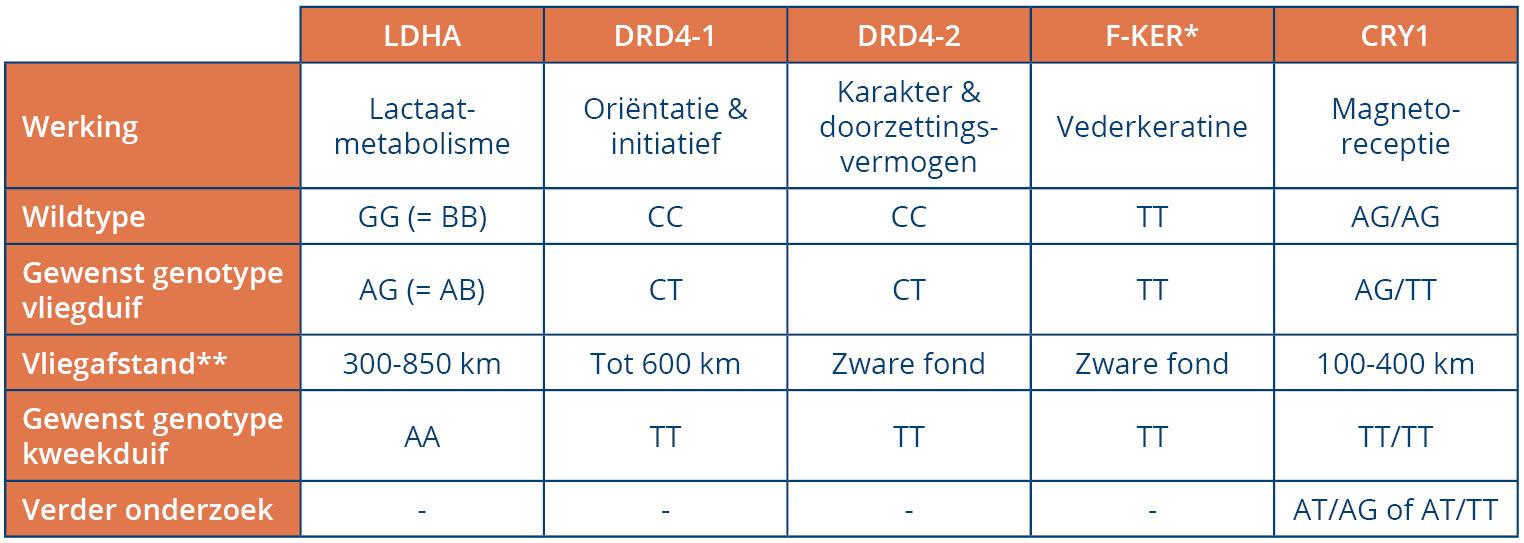
Note: Certain combinations do not occur (currently)
* Unlike the other genes, the mutation (G) at F-KER is undesirable (detrimental for long-distance flights)
** These are the distances that, according to research, provide a significant advantage for the respective marker. Generally, longer distances are also tested. However, due to the lower number of pigeons, significance cannot always be determined - although it is clearly visible. We therefore assume that pigeons also benefit from all point mutations at longer distances.
LDHA (Lactate dehydrogenase gene type A)
Lactate dehydrogenase, an enzyme coded by the LDHA gene, plays a well-known role in our physical and mental health. The point mutation on the LDHA gene is located on an intron. Such a change in an intron can affect how often the gene is used to make the protein. This is called gene expression. However, when we look at the point mutation in the LDHA gene in pigeons, it is still unclear how this mutation, based solely on the altered enzyme activity, influences their flight performance. There may be other unknown mutations that are inherited alongside the LDHAA allele and also impact flight performance.
Scientific research undeniably shows that selection based on the LDHAA allele in racing pigeons can improve the genetic quality of their performance. In short, by selectively breeding based on this allele, we can optimize the performance of racing pigeons. From some studies with a limited sample in a standard Belgian group of racing pigeons, it appears that about 3.74% has the LDHAAA genotype. Additionally, approximately 22.42% has the LDHAAG genotype (= LDHAAB genotype). These percentages are likely even on the high side. Among the pigeons that perform best, however, the LDHAA allele occurs more frequently.
DRD4 (Dopamine receptor gene type D4)
Dopamine is a neurotransmitter that plays a role in various crucial bodily functions. To be effective, dopamine binds to specific receptors called dopamine receptors. In our brains, there are 5 types of these receptors, namely D1 to D5. They mainly influence the behavior of pigeons. The precise mechanism by which point mutations in the DRD4 gene influence the performance of pigeons still needs further investigation.
Two point mutations are tested together on the DRD4 gene: DRD4-1 and DRD4-2. These are presented as one result, with the 2 front letters for DRD4-1 and the 2 back letters for DRD4-2. The DRD4CTCT variant is significantly more present in the best performing pigeons. Most double heterozygotes (CTCT individuals) were found among the best performing pigeons in extreme long-distance flights. Literature studies of a Belgian group of racing pigeons show that 91.59% has the DRD4-1CC genotype and 8.41% has the DRD4-1CT genotype.
DRD4-1 is suspected to influence orientation and initiative
DRD4-2 is suspected to influence character and perseverance
F-KER (Feather keratin gene)
A recently discovered quality indicator is a variation in the feather keratin gene (F-KER). This specific mutation in the keratin gene results in a change of the amino acid cysteine to glycine at the 83rd position of the protein (Cys83Gly). This genetic change or mutation (FKERG allele) leads to an anomaly in the keratin protein and is associated with reduced performance in racing pigeons during long flights. Notably, the F-KERTT version, the original type or wild type, occurs much more frequently in pigeons excelling in long-distance flights (more than 500 km) than the F-KERGG variant.
The fact that some leading pigeons have the G allele, even though it generally has a negative impact on performance, shows that relying solely on this genetic indicator is not enough to breed an excellent pigeon. At the same time, this suggests that there is still room for genetic optimization using genetic markers, especially with the very best pigeons.
CRY1 (Cryptochrome-1 gene)
The cryptochrome-1 gene (CRY1) appears to be a very important factor for good flying performance in pigeons. In other birds, it has already been shown that the sense of the earth's magnetic field, which helps with orientation, is connected to certain proteins in the eye. There is now some evidence in pigeons as well that cryptochromes also play a role in perceiving the earth's magnetic field, which helps them navigate while flying. These specific proteins, known as cryptochromes, function as a type of magnetic sensor. They are also involved in regulating circadian rhythms (the internal "clock") for distinguishing day and night and perceiving UV light. CRY1 is a dinucleotide polymorphism located at an intron, where 2 nucleotides differ simultaneously at a mutation. Such a change in an intron can influence how frequently the gene is used to make the protein. This is called gene expression.
Within the CRY1 gene of pigeons, initially 2 variants or alleles, AG and TT, were identified and studied. It was shown that pigeons with the CRY1AG/TT genotype achieve significantly better results. However, later a 3rd variant or allele (AT) was discovered through thorough research at NeorniLab. More research is needed to fully understand this AT variant.
Source: http://www.neornilab.be