

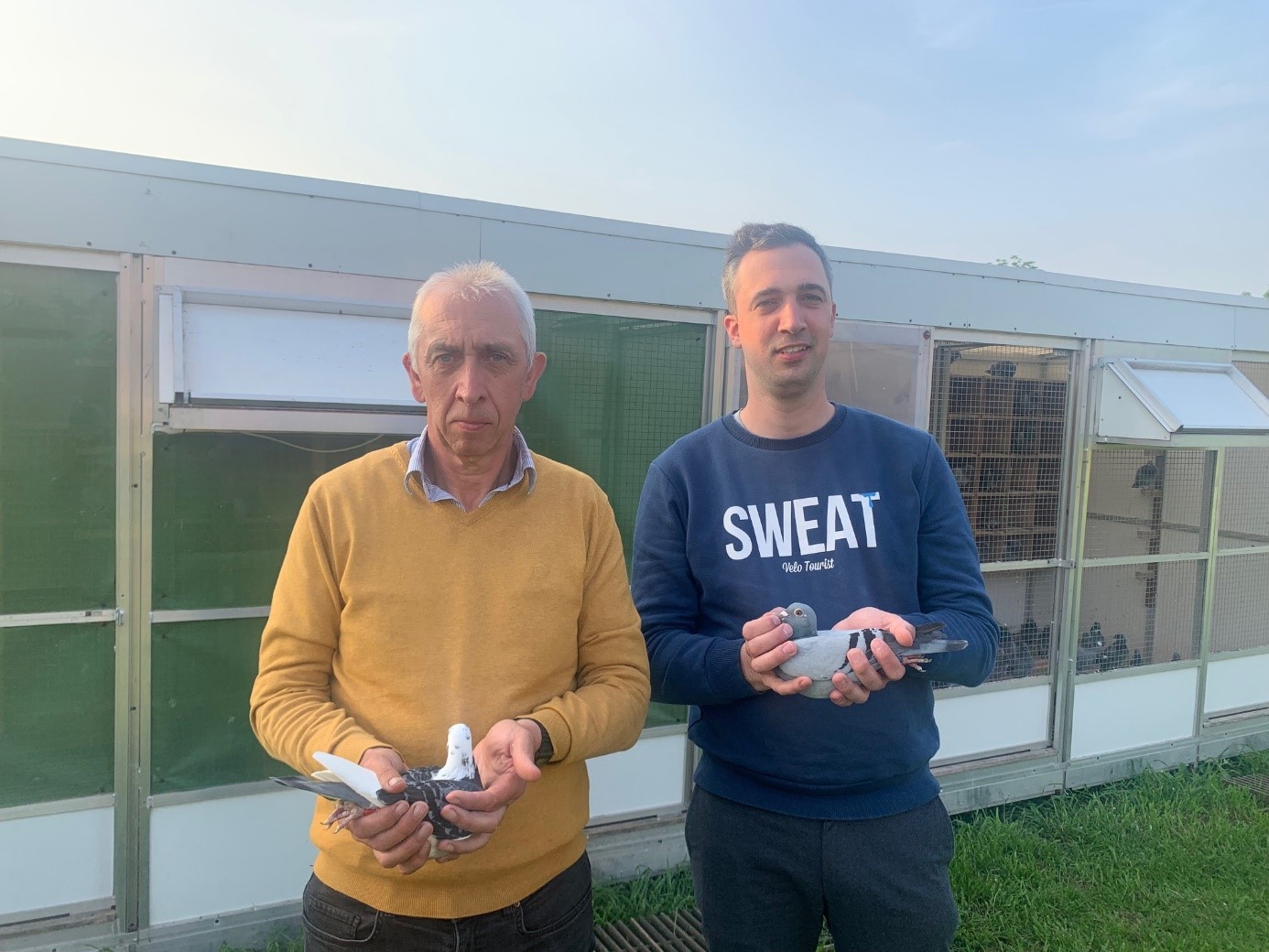
Breeding as pigeons seems to be deeply ingrained in the Bombeke family, as while last year we introduced flying wonder "Kyra," this year it's already the turn of another top bird, namely.
"Noor": 2nd Provincial As Pigeon Hafo Allround, 15th National As Pigeon, and 5th World Best Pigeon 2024.
This exceptional hen with impressive performances was bred from a direct sister of Kyra, demonstrating that at Bombeke, the apples do not fall far from the tree. The better pigeons largely come from the same proven family, namely that of the golden breeding pair “551/14” x “554/14” Fabienne.

History
Like many pigeon enthusiasts, the story of Luc & Dries begins with previous generations. Georges Bombeke, Luc's father, had already been involved with the pigeons and passed on the passion. Dries, who in turn caught the passion from his father, still lives at home and has taken over his grandfather Aimé Glorieux's loft, who lives next door. Thus, at the Bombeke household, pigeon sport remains a true family affair.
At Luc's, the pigeons are housed in garden lofts, with around 20 males and 32 females played on the classic widowhood system. The first round of youngsters goes to Luc and is played here on the sliding door. Dries, on the other hand, focuses mainly on the old and yearlings. Since the start of an open aviary in 2022, they also compete in heavy middle-distance races, using complete widowhood since 2023. Dries plans to eventually tackle heavy long-distance flights and international races. This is, of course, a multi-year plan. The youngsters from the second round land with Dries and serve primarily as reserves and are trained well.
The Breeds
To start at the beginning: the original Bombeke breed of Luc. In 2006, 2 top breeders and the founders of the current breed were obtained from Guido Van Caneghem. Later, many pigeons came from Bauters Jo, known for his "Fabian." Direct descendants of this top pigeon are present.
Later, in 2016, some pigeons were acquired from Friend Tom Van Gaver. They received a few eggs from yearlings. Yearlings that later grew into icons like Finn, Magic Bart, grandchildren Ricky, White Finn,... Through his friendship with Tom Van Gaver, Dries also became friends with Bart Geerinckx, from whom some pigeons were acquired through a donation, including a grandchild Gladiator.
In 2019 and 2023, several donations/eggs were purchased from Gino Clicque. Including grandchildren of Golden Prince, Prince Rudy, national winners, and national as pigeons. Also, pigeons were obtained from Team Baetens while working with BRICON, including a brother of the 5th national as pigeon ‘214’ and children of RAX, the 2nd national as pigeon.
For the heavy long-distance, pigeons have also been obtained in recent years from "de Molenaar," the 1st national as pigeon, from Camiel Van De Sande.
Important influences came further from Gilbert Oosterlinck (Oosterzele) as a supplier of the father of Noor! And also pigeons from Stan De Troyer (De Troyer-Baeyens, Lierde), which especially had a big influence on the sprint flights.
System for Old & Females
At Luc, the system is as follows: the effective old pigeons are paired together with the breeders and produce a couple of youngsters. The yearlings are not paired with the winter breeding (because the youngsters are brought to light, they are not yet fully through the molt at that moment). Before the season, all males are paired the last weekend of March to breed for about 10 days and train. From then on, the classic widowhood starts. The racing hens are paired the first weekend of April and remain together until the end of breeding.
The System at Dries
Due to the busyness around his construction project, there were some drastic adjustments in Dries's system this year. Thus, the old and yearlings were played on “chaos.” Dries: “The sexes, which had been separated since September 2023, only came together during the first training flight and saw their boxes for the first time. This resulted in a peak period at the end of April-May, where the old pigeons consistently performed well until the end. For the yearlings, there was some decline in performance towards the end. Therefore, we will return to our old system in the coming season, where the racing pigeons raise the second round of breeders and thus are paired the first weekend of January. Afterwards, they remain separated until learning and then stay together for another 4 days.”
System for Young Pigeons
Early young pigeons are bred (the first round goes to the lofts at Luc), these are vaccinated against Paramyxo-Rota at the end of February and against the pox two weeks later. Only the first round is darkened, from the hour switch at the end of March until June 21. They are also lighted from the longest day, and this is maintained until the end of the season.
The young pigeons from the first round are introduced to flying from the beginning of March to fly for +/-10 minutes; once they do this for 3 days, they begin to do this automatically, and after a while, they train for 45 minutes to 1 hour. It sometimes happens that they fly up to 1 hour and 30 minutes already in April and are away for some time; then you know they are ready to go into the training basket. Training is done stepwise from 5 km – 10 km -15 km -20 km (Ronse). They usually do not go further; from then on, the youngsters go with the society to Doornik (45km), usually doing this twice, however, in the last 2 years, the second time was for Niergnies as a training flight instead of the second time to Doornik. Then they usually go a couple of times to Noyon interprovincial to gain some experience, and they are ready for what is to come. As motivation, they play this round on the sliding door. The pigeons begin widowhood at the beginning of July until the end of the season.
The second round, which is not darkened and is in the aviary, is handled much less carefully. They are less often trained and are faster introduced to the interprovincial releases in Noyon.
In 2024, the youngsters were only released on April 4 due to the construction pressure. Nevertheless, they could participate in their first "big" Noyon from June 26 and did another 6x Noyon in preparation for 2025.
Day Fond – A Successful New Approach!
Last year, we mentioned that Luc and Dries wanted to use a loft of hens for the day fond. This year, it succeeded, with brilliant results:
Limoges I:
- Local 320 Old: 1st, 8th, 23rd (3/5)
- National: 25th, 206th (10,653 participants)
Tulle I:
- Local 225 Old: 2nd (2/4)
- National: 48th
- Yearlings 153: 4th, 11th, 30th (6/8)
Limoges II:
- Local 181 Old: 1st, 3rd, 8th, 21st (5/9)
- National: 133rd, 213th
- Yearlings: 4th, 8th, 25th, 26th (9/12)
Souillac:
- Old 97 o: 2nd, 3rd, 28th (3/3)
- National: 26th, 163rd
- JL 80: 3rd
Brive:
- Old: 5th, 10th, 12th (4/5)
- Yearlings: 2nd, 9th (2/4)
- National Old: 77th, Yearlings: 83rd
Bergerac:
- Yearlings: 1st, 17th (2/2)
- National: 59th (3180 participants)
Tulle II:
- Yearlings: 1st, 7th, 9th, 12th, 23rd, 25th (8/9)
- National: 57th (5753 participants)
References
Results of 7 pigeons at Robert Lech (Poland) with the breed of Bombeke Luc & Dries
- 20/5816 (725km)
- 7/4509 (340 km)
- 10/5099 (243 km)
- 28/2988 (516 km)
- 55/5093 (243 km)
- 24/3673 (516 km)
- 23/3673 (516 km)
- 5/2988 (516 km)
- 12/5966(243 km)
- 3/2695 (158 km)
- 8/3038 (243 km)
- 8/2712 (340 km)
"Miss Bombeke" at Van Gaver Tom and Marnic