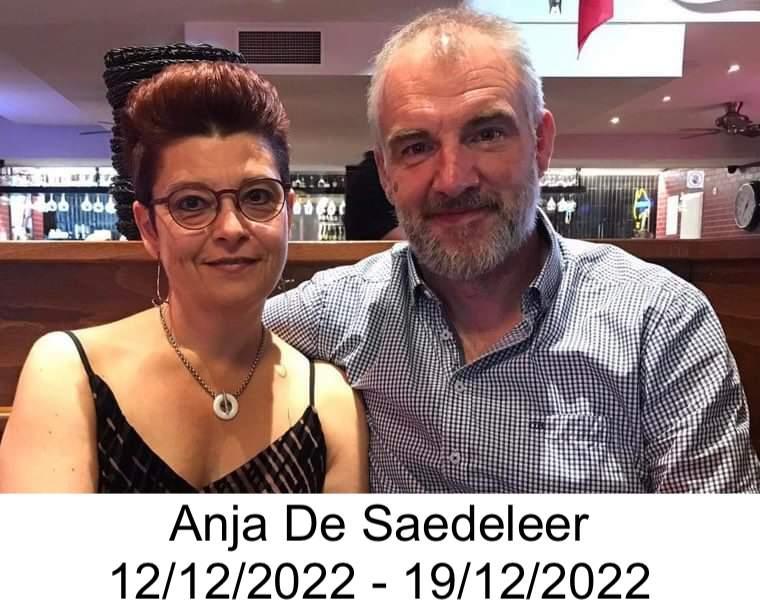
With 10 provincial and 4 zonal victories in recent years, we can accurately classify Rik De Nayer and his wife Anja as East-Flemish top performers. 19 specimens from the heart of this super colony are ready to change owners.
History
Anja's husband, Rik De Nayer, has already played in tandem with his father Willy in Ressegem. After the couple had a house built in Denderleeuw, a pigeon loft was, of course, a necessity.
This was easier said than done, as the house is located in a social housing area, requiring changes to the subdivision conditions to allow the placement of a pigeon loft. Many years passed, but eventually, it was sorted out. They opted to start under the name De Saedeleer Anja, but the actual fancier is Rik, while Anja only steps in when he cannot be present due to work.
Initially, they started racing from Liefkenshage in Denderleeuw with sprints, later moving toward small and large middle-distance races. At first, these were with pigeons from Sonja van der Maelen via Sonja's in-laws, Van Den Bossche – Lauwerijs from Woubrechtegem.
Pigeons were acquired from Gaston De Temmerman from Sint-Maria-Lierde, from father Nestor De Saedeleer and father-in-law Willy De Nayer, and later they also reached out to Jean Meulemans from Teralfene.
In 2013, reinforcements were obtained from Marniek De Neve, with whom Rik and Anja are still very satisfied, and in 2018 from John Rockx from Zegge (NL).
Good pigeons also came from Peter Crans from Den Helder ("the champion in a few square meters"), a few came through bons from Fernand and Koen Marien from Kasterlee, and at Jan and Jannus Kat, they acquired the mother of the provincial Bourges winner 2022.
At Team Noël-Willockx from Baasrode, Anja and Rik cannot go wrong; Eddy also assists them with advice and practical help if they have questions about feeding and more.
Focus on Old and Yearlings
Depending on the weather, the pairing of the 25 pairs of breeding pigeons takes place around December 6. They raise 2 rounds of about 50 young pigeons each.
They do not participate in the young pigeon races. They are not darkened, given additional light, or motivated and simply need to be let out a few times. Rik: "Since we don’t really follow the young pigeon racing, we are also not the quickest to train the pigeons. We try to take them out about eight times (2x 3km, 2x 8km, 2x 16km, and then 1 or 2x 30km, after which they can join the association. Depending on the wind, this could be straight to Noyon (with the wind) or at least Quievrain against the wind. Performance is not considered. Selection is straightforward and can be done by anyone. Anyone can pick out an ugly pigeon, and no one can look into its head."
The racing season starts with 32 males and 40 females. These pigeons are not paired in advance; the famous "chaos system” has been used successfully for over 10 years, although there is always some doubt about returning to the old method every winter. During training, males and females go out separately about four times (1x 5km, 2x 16km, and 1x 30km); they do not come home together. The first time everything comes home together is after their first race. At the beginning of the season, both males and females participate; after the second or third national flight, the males stay home, and they only continue with the females. These go to nest to provide an extra boost at the end of the season.
Lofts and Care
For feed, by-products, supplements, and feeding schedules, the complete system of "Aïdi" is applied. After the season and a month before the start of the flying season, an appointment is made with veterinarian Ruben Lancriet. This can also happen after a bad weekend, but that is more for the mindset or reassurance of the fancier.
Both for breeding and the flying season, a treatment for paratyphoid is scheduled annually, usually with a different product and sometimes preceded by another antibiotic treatment, depending on whether other issues have manifested.
A few weeks before the start, the mandatory paramyxo vaccination occurs, and possibly a trichomoniasis treatment.
"For the rest, we try to give little to no medication: the best seasons are those where the medicine cabinet has remained closed. If something is wrong, you must act immediately and not delay. The use of medication always has a backlash, if not in the short term, then certainly in the long term. With the young pigeons, we have been doing a Paramyxo/Rota vaccination for about four years with very good results. Since then, young pigeon disease has almost disappeared," says Rik.
"We built the loft ourselves; the panels are made of 'Print' material, a composite board that does not absorb moisture, and the roof is a traditional tile as we have laid on our house's roof. As we live in a social subdivision, the ridge height is limited to 2.5 meters. We would have preferred it to be higher and off the ground, but it is what it is.
It is certainly not an ideal loft; we need some wind to create better ventilation."
Some Results
- 1st provincial Argenton 2004
- 1st provincial Argenton 2008
- 1st provincial La Souteraine 2015
- 1st provincial Bourges 2016
- 1st provincial Bourges 2018
- 1st provincial Argenton 2018
- 1st provincial Argenton 2018
- 1st provincial Chateauroux 2020
- 1st provincial Bourges 2021
- 1st provincial Bourges 2022
- 1st national Zone B1 Bourges 2017
- 1st national Zone B1 Argenton 2018
- 1st national Zone B1 Chateauroux 2021
- 1st national Zone B1 Bourges 2021